What innovation infrastructure does arts, culture & heritage need now and in the future?
And what role might the newly proposed ACE Innovation and Development Service play?

From organisational support to innovation infrastructure
There’s lots to say about the new ACE framework and, for now, the bit I’m most interested in is the proposal to “help the sector to grow and change by establishing a single Innovation and Development Service.” This is good news. But only if it’s shaped by a new approach to innovation in the sector.
That line in the ACE framework could easily be read as a promise of more support for individual organisations: more advice, more toolkits, more business development, more R&D grants. And as a consultant in this space, that should make me happy.
This is not an argument against organisational support. That will still be needed. But if the Innovation and Development Service, and related policy / funding mechanisms, stop at organisational support, it will miss the bigger opportunity.
Many of the challenges facing us are persistent and structural and cannot be solved organisation by organisation.
My core idea is simple: if we are serious about innovation, then the unit of change has to shift.
Not just innovation at the organisational level.
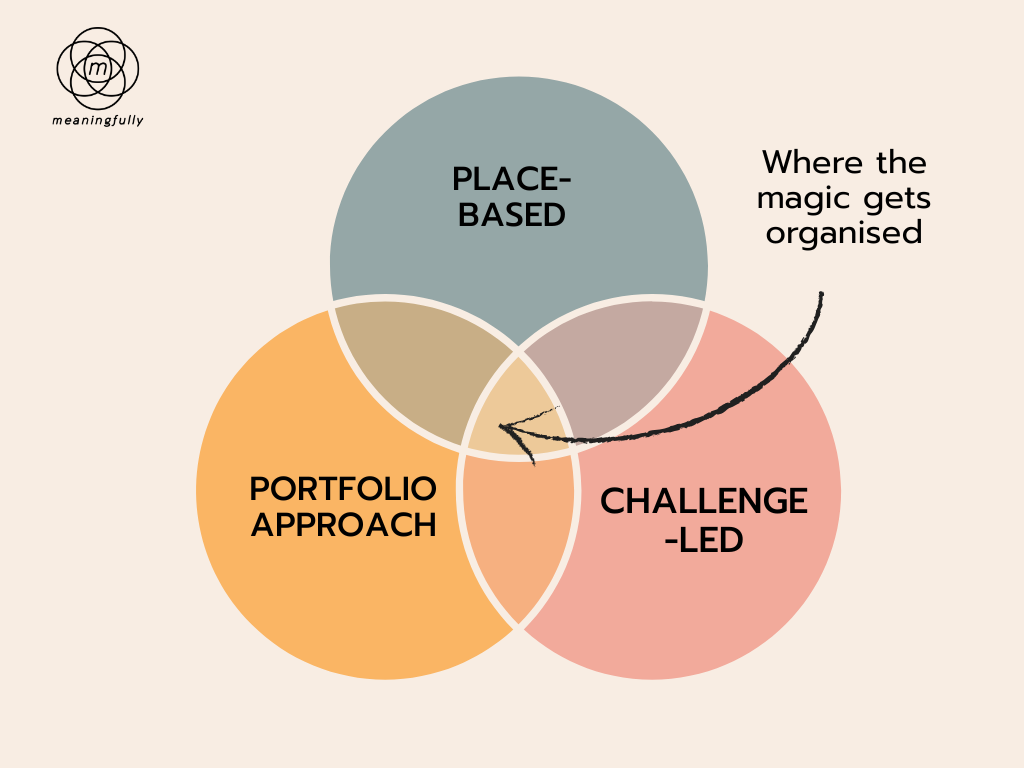
But at the portfolio, place and shared challenge/mission level.
These ideas are informed by, and build upon, conversations with Simon Cronshaw, Lisa Westcott Wilkins and Brendon Wilkins, which led to the launch of The New Cultural Entrepreneurs (and series of companion pieces) earlier this year.
It also draws on practice in the social innovation world where I spend some of my time and is inspired by the work of Ingrid Burkett on systems innovation.
The bigger opportunity
That means building something that is not just a service or support mechanism, but a set of conditions, incentives and national innovation infrastructure for coordinated, challenge-led and place-based R&D.
By innovation infrastructure, I mean the conditions that allow multiple organisations, funders, civic partners, artists, communities and researchers to work on shared areas of interest, learn in common and in public, and move successful practice into wider use. I’m also thinking mainly about business innovation rather than creative R&D more broadly.
It feels important to name something else at this point, which is that we are not outside the funding system, we are in relationship with it. In partnership. We all need to take responsibility for shaping the questions, evidence and alliances that will make the next strategy stronger.
The next full ACE strategy will take time, as it should. So, while that work is underway, we can begin to organise our questions, test where there is shared appetite and energy to act and set some strategic enquiries to help us explore what kind of innovation and development system we actually need.
Here are some of my thoughts on innovation.
Three strategic enquiries
How can we move from isolated pilots to a genuine portfolio approach to research, development and innovation?
How can challenge-led innovation help the sector build shared capability that no single organisation can create alone?
How can place become an innovation lab for shared civic challenges and missions?
1. How could research, development and innovation be organised so that experiments connect, learn and build from each other and contribute to wider change?
The first enquiry is about how we fund, connect and learn from experimentation together, as a genuine portfolio of practice, not just in name.
The cultural sector is very good at pilots. But we are less good at connecting them.
Projects in a connected portfolio might intervene at different points in the same system: a place, an art form, a value chain… They might test different assumptions around the same idea. They might explore a shared challenge from different places, scales or perspectives.
The important thing is that these experiments would not sit alone. They would learn from each other and iterate together. They would respond to shared central questions and gather some shared measures. Crucially, they would have spaces to convene, compare methods, insight, data and experience. They would be able to pivot together as learning emerges.
This would require a different culture of accountability, with less emphasis on what each individual project delivered and more emphasis on whether the portfolio as a whole is generating useful knowledge, strengthening relationships, changing practice and opening new possibilities.
This shift from confetti to spaghetti (from scattered projects to connected strands of learning) is well documented in social innovation spaces and could easily be translated to arts, culture and heritage.
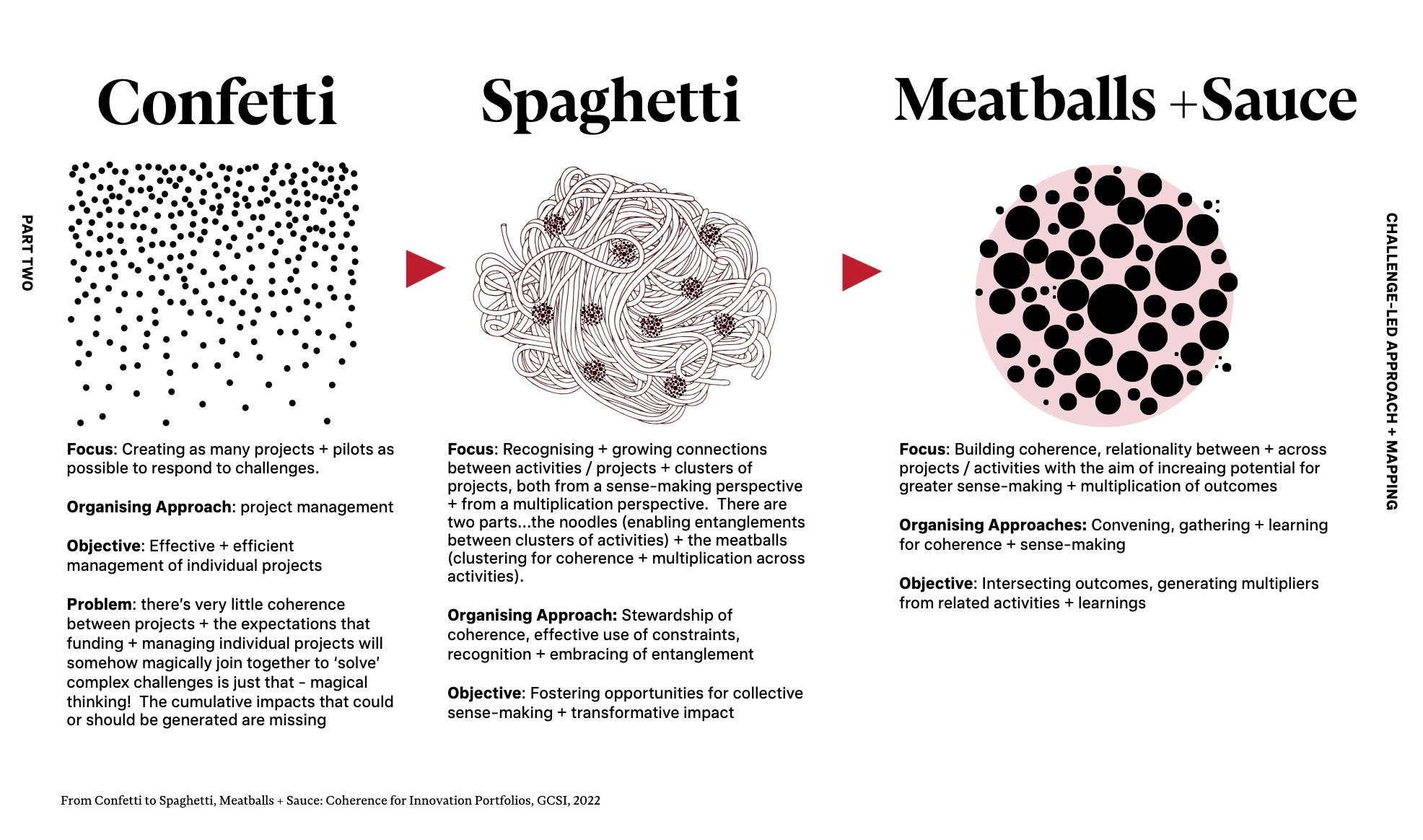
Source: Challenge-led Innovation. Organising for systems level change at scale. Griffith University. Griffith Centre for Systems Innovation. Nov 2023.
2. What conditions and incentives would help the sector develop shared capabilities that no single organisation can create alone?
The second enquiry is about how we might create better conditions for shared capability and even aggregation.
There are so many things individual organisations are currently expected to understand, develop, procure or manage alone, even when it makes little sense for them to do so.
AI is an obvious example. So is distribution, which we know is an untapped opportunity for business model development.
Larger organisations may have some of the skills, assets and resources but not always the incentive or structures to share them. Smaller organisations and independent practitioners may have the ideas and agility, but not the infrastructure. Local authorities may have convening power and civic legitimacy, but not specialist cultural R&D capacity. Funders may have strategic overview, but not the live, grounded intelligence that sits in communities and practice.
Innovations at the individual or project level are all good. They have impact and they give us inspirational case studies. But they rarely create systemic change.
This is where challenge-led innovation comes in. Rather than asking every organisation to invent its own fragile workaround, a new approach to innovation could help incentivise the sector organise around shared challenges and build common capability, repeatable methods, trusted relationships, shared intelligence and coordinated routes to scale.
I’m using challenge-led deliberately here, because not every enquiry needs to become a full mission. But where there is enough shared urgency, capability and commitment, challenge-led R&D could mature into mission-led innovation.
3. How can places organise cultural R&D around the challenges, assets and futures that matter locally?
The third enquiry is about place, agency and civic relevance.
What would it mean to treat culture as part of the R&D infrastructure of a place? As a way of imagining, testing, prototyping and making change with communities.
A place-based innovation approach could bring together cultural organisations, artists, local authorities, health partners, education, universities, businesses, funders and residents around shared local challenges. Those challenges (or missions) might be about youth wellbeing, climate adaptation, loneliness, town-centre renewal, creative skills, public trust, local identity or intergenerational connection.
Or the model could be a collective of arts organisations all exploring one area of business model development together, such as distribution or new pricing mechanisms.
Having said that, if place-based R&D simply means national priorities delivered locally, we will have missed the point. The challenges and missions must be shaped by local intelligence, lived experience and creative practice, as well as by policy priorities. Otherwise, place becomes just another delivery geography: a cold spot, a target area, a funding priority.
This also changes how we think about infrastructure. The infrastructure of place is not only buildings, venues and public spaces. It is also relationships, trust, local knowledge, civic legitimacy, community leadership, creative practice, data, convening power and the ability to learn together over time.
A new Innovation and Development Service could support place-based innovation by helping places organise around challenges or missions, connect local experiments into wider portfolios, and make sure learning travels between places without flattening local difference.
Where the magic gets organised
So what might some of this look like in practice?
Funded connected challenges, not isolated pilots
Design innovation funding around shared challenges (or missions), rather than small, time-limited grants to individual organisations working separately.Challenges shaped by the people closest to it
Artists, creative entrepreneurs, communities, civic partners and local assemblies should help define the challenges, with funders acting as stewards, convenors and enablers rather than setting the agenda alone.Place as one organising unit
Support demonstrator places (from post codes to regions), local challenge funds, civic R&D labs and regional learning cohorts where cultural organisations, local authorities, communities and partners can test new approaches together.Larger institutions as R&D platforms
Encourage larger organisations to open up their assets, spaces, collections, data, expertise and commissioning power through curated open calls and paid experiments with the wider creative ecosystem.Portfolios of experiments
Fund groups of connected projects that test different aspects of the same challenge, within a value chain or art form, with shared questions, shared learning and opportunities to adapt as insight emerges.Support for the whole innovation process, not just the idea
Help organisations and partnerships design the practical machinery of innovation: stage-gates, learning metrics, dashboards, incremental funding, risk frameworks, ring-fenced R&D budgets and routes to adoption.Shared legal, financial and governance tools
Develop practical templates and support around open IP, fair revenue sharing, data, procurement, evaluation and partnership agreements so collaboration becomes easier and less risky.Adoption as part of the funding model
Build in support and resource for what happens after the pilot, to help successful experiments to travel and adapt for different contexts.Self-led action labs
Support self-organised groups of artists, producers, organisations and civic partners to come together around their own strategic enquiries, test small-scale ideas quickly, and share what they learn.
From support service to shared system
We need an approach to business innovation and development that is organised around different units of change and recognises that the major challenges facing arts, culture and heritage are interconnected. They therefore require coordinated, portfolio responses that are place-based, challenge-led, or both.
It also means taking adoption seriously. Too much R&D stops at the point where implementation should begin. If an experiment works, who helps it travel? Who adapts it for different places? Who supports the next stage of development? Who owns the IP? Who benefits? Who pays for the transition from prototype to practice? What role might an Innovation and Development Service play at this end of the process?
None of this is a new idea in isolation. Portfolio approaches are already used in public-sector innovation to avoid fragmentation. Mission-oriented innovation has shown how R&D can be organised around shared societal challenges. Place-based transformation work has shown that local systems are not just delivery contexts, but active sites of innovation. And in the cultural field, AHRC’s Creative Communities and Creative Industries Clusters have already begun to demonstrate what cross-sector, place-based cultural R&D can look like.
My hope is that the Innovation and Development Service does not become another layer of organisational support, however well intentioned. And that the policy and potential funding streams surrounding this follows some of the principles I’ve set out here. The opportunity is to learn from these approaches, and build something more ambitious and relational that helps the sector ask better questions, together.