
Can thinking like an artist save us?
Art thinking: question making, worldbuilding, emergence

Art is one of the few spheres that can hold the complexity of our times. As we move through late-stage capitalism into the unknown, how will we navigate and who will lead us? I believe that art is a catalyst for hope and have been reflecting on the idea of art thinking, and wondering why it hasn’t gained more traction in recent years.
Creative question making
Ars Electronica have been incubating the idea of art thinking for several decades and describe it broadly as:
a process of applying artistic thinking and an artful view to a broader range of challenges.
Working at the intersection of art, science, technology, design, entrepreneurship and activism, their work seeks to address the central questions of our future through transdisciplinary collaborations and a focus on new technologies.
Based at FutureLab, a research stream at Ars Electronica, Hideaki Ogawa’s work focusses on the question making power of art thinking. They propose the following simple distinction between art and design thinking:
Art creates creative questions and design creates the creative solutions.
This emphasis on creative questions to ‘look for new directions’ and ‘see the possibilities’ really resonates with me as coach. The art of question making is central and critical to the coaching process, which also intends to help shift paradigms, challenge the status quo, and lead to breakthroughs that we haven’t imagined yet.
Their process has been distilled neatly into a journey from inspiration to prototype.
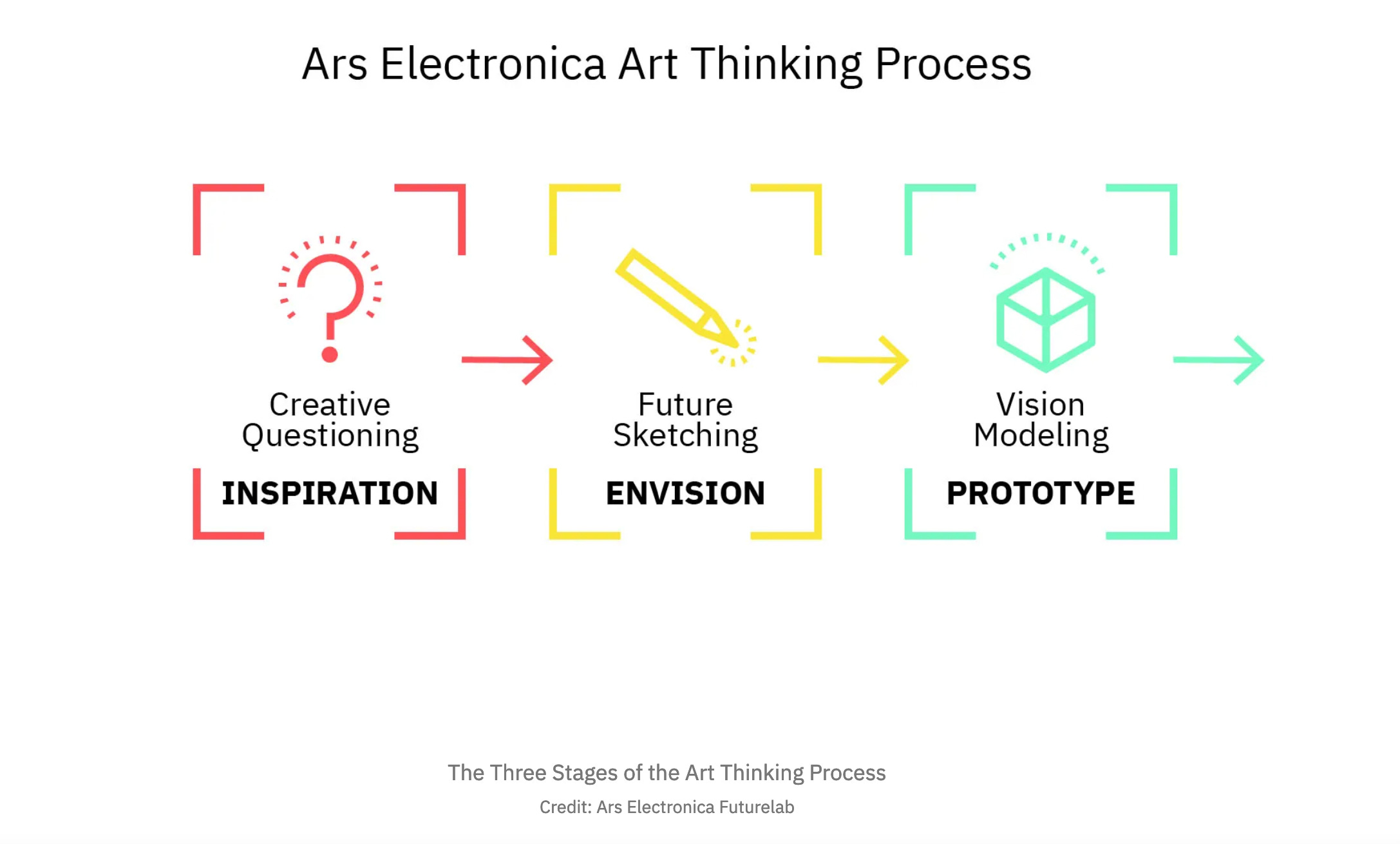
Published with the permission of Hideaki Ogawa, copyright Ars Electronica Futurelab
Worldbuilding
Having read Amy Whitaker’s Art Thinking: How to Carve Out Creative Space in a World of Schedules, Budgets, and Bosses in 2017, I was sure an explosion of art thinking debate and application would ensue. It felt so timely. And the central idea behind Amy’s approach was simple yet powerful:
If you are making art in any field, you are not going from point A to point B. You are inventing point B.
Inventing point B got me thinking about worldbuilding and the way in which artists conceive new realities and help us to immerse ourselves in these worlds through their words, images and experiences.
During my time as director at Haarlem Artspace, we engaged artists Isik Sayarer and Eva Knutsdotter, working collectively as Fourthland, to conduct a two day visioning workshop with the board. Part of the process involved creating a 3D landscape of Haarlem and its ecology that we could journey through and around. This allowed us to feel and see this landscape from a range of perspectives that just wouldn’t have been possible otherwise. This was next level creative facilitation - a truely magical exploration that enabled breakthrough conversations and the paradigm shift we needed.
I recently discovered the The Art Thinking Network whose method, developed by Sylvain Bureau, follows a similar theory to Ars Electonica, but looks quite different in practice:
Through the method, you can generate a situation that you have never thought of before and that does not yet exist. This new and unlikely situation poses a new question that allows us to question our systems and the status quo. This new question then offers the possibility to go beyond what is and consider other possibilities.
Importantly, this Art Thinking Method is a practical workshop process through which artworks are actually made and exhibited. While I haven’t taken part in one myself, I’m intrigued by this model and can imagine the benefits of discovery through making. The process of art thinking is surely not just thinking, but sensing, making and being?

Emergence
The value in art thinking lies in its distinctive characteristics. Art thinking for me is:
Expansive
Non-linear
Intuitive
Risk-taking
Full of possibility
Embodied
Critical
Emergent
Emergence feels like THE essential quality required of any strategic or problem-solving approach right now.
Afterall, we are living in a polycrisis. The pace of change in every aspect of our lives not only creates ambiguity and uncertainly, but chaos and crisis. Traditional, so called tried and tested, methods are becoming more and more obsolete each day.
In her work, Whitaker advocates for having a “lighthouse question” - a question that really matters to you and warrants exploration. She frames art thinking as the process of working through this question by accepting the absence of answers and templates, and thus embracing the inherent complexity and uncertainty that this requires.
Working emergently and playing with the unknown is not something everyone can do. It’s a superpower. A superpower that artists inherently possess and effortlessly hone with grace and ease.
So why don’t we hear more about art thinking?
Since the 50’s and 60’s, we’ve seen design thinking emerge as a concept and evolve from the realm of product development to an essential element of the innovation toolbox. From individual business problems, to helping solve societies biggest challenges, design thinking has had a seat at the table since IDEO’s Tim Brown popularised the concept in the early 90’s, helping us rethink the value of design.
So why haven’t we seen the same for art thinking?
In this 2013 article, Whitaker also explains that
The main, paradoxical gift of art thinking is its freedom from productivity. Wasted time might be exactly the lateral move that opens up the field of play.
And while this break from the myth of productivity feels even more timely right now, I suspect it’s also one of the reasons that art thinking hasn’t gained traction. The focus on predetermined outputs and outcomes is still prevalent, making the argument for pure experimentation and discovery, a really hard sell.
Art thinking is compatible and complimentary to design thinking and agile methods. And there are some trailblazing agencies out there already applying art thinking models to social innovation. But despite the many benefits and the need for different approaches, the concept still feels like it’s on the fringes.
I’m in favour of trying to map, articulate and codify our own creative processes to apply them (or elements of them) to the creation of our strategies. Just imagine what it might look like on a more macro level.
Many of the artists I work with have no interest in applying their practice to anything but making art, and I don’t blame them. Perhaps art thinking needs more time to breakthrough - after all design thinking has been in the making for almost 70 years.
At its highest level, I understand art thinking as the process of developing the question as well as answering it and the process of discovering the future by making it.
My personal hope is that art thinking - BY ARTISTS - becomes an essential ingredient of every business innovation team, academic research collaboration, and government advisory body that genuinely seeks to find a better way. Imagining a different future is essential, and so is creating the questions, conditions, and collaborations to help us get there.
Thanks Joe so pleased this resonated! Many of the artists I work with are systems thinkers, although they don’t use that terminology. They see the whole and not just the parts is how most would explain their world view. I’m really interested to see where your thinking and writing goes on this subject. Making these connections is going to be so important to help us solve our big challenges 👏🏼👏🏼👏🏼
This is Brilliant Ellen!