
Relational Growth: The Constellations That Sustain My Business
Reflections on growing a business through relationship not reach, and how I've built a business with almost zero online presence.

This piece draws on my annual business review process, which I complete each August. This year, I took a retrospective look back over ten years of running my own business. If you’re building a service-based business and shy away from social media (as I do), my experience might resonate. This is what has worked for me.
Word of Mouth and Nuturing my Network
Word of mouth and referals from my exisitng network have consistently generated between 45% and 55% of my work since I launched my business in 2015. It’s worth mentioning that I came into this field some connections that I’d built up for 15 years as an employee before going freelance.

Close up of a dandlion clock
The Magic of Curious Conversations (and a serious coffee budget)
When I first went freelance, I didn’t have business plan. I took the path that I suggest to my clients and treated the first year as test trading, experimenting with service offers, seeing what landed and felt right, and exploring where the opportunities for me might be.
I didn’t have much of a financial cushion though, so I had to be proactive. I got in touch with as many people in my network as I could think of to arrange a coffee and a catch up. I didn’t pitch myself, instead I treated these as curious, exploratory conversations to find out what people were working on, what they saw on the horizon, and to share some of my emerging intentions. Some of these conversations led to small commissions which paid the bills, but most were an opportunity to reconnect, deepen existing relationships and get some valuable feedback on my ideas.
I maintain this practice to do this day. Curious Conversations tend to happen online or on the phone, but the principle is the same and simple - exploratory chats, keeping in touch, sharing updates and bouncing around ideas. It’s never wasted time.
Good Boss Karma
I haven’t line managed that many people over the years to be honest. But some of brilliant people that I’ve had the privilege to lead, have gone on to do incredible things. Relationships with two of my longstanding clients - The British Council and University of the Arts London - can be traced back to people I used to line manage. I think of it as good boss karma. I’m hugely grateful to Erin, Emma and Imogen for creating these opportunities for me and I don’t take them for granted.
Reaching New Audiences through Training and Speaking Gigs
Training and facilitation accounts for about a third of my income. Crucially, these ‘one to many’ gigs serve as network and ecosystem building activities and afford me the opportunity to reach new audiences and forge new relationships, the benefits of which are often reaped years later.
For example, back in 2015, I delivered my first training programme as a freelancer at the Museum of Oxford called Business Modelling for Creatives. I stayed in touch with the participants and some years later, one of the artists on the programme took a job as an innovation manager at a university (talk about multi-hyphanite!). They brought me in to deliver a programme for early career researchers, which ran for two years. This led to another opportunity to run an innovation programme for social workers, which is now in it’s fourth year.
Genuine Generosity and Cross Referrals
If I see something that I think someone might like, I send it to them. If get approached for a piece of work that either isn’t in my wheelhouse or I don’t have the capacity to do, I always suggest someone else who might be able to help and make a direct referral. I don’t think these small acts of generosity go unnoticed. It’s not why I do them, but work definitely comes back to me this way.
Pitching
Taking the leap to work for myself is one of the best decisions I ever made. The freedom, autonomy, variety and creativity that a self-directed portfolio can provide is priceless to me. But that doesn’t mean that I always want to work alone.
In the early days, I would pitch for small pieces of consultancy on my own, but I rarely do that now. Work that I pitch for individually has has accounted for between 10% and 37% of my income (at the higher end in those earlier years).
Instead, if I see tenders for projects that have an Ellen shaped piece of work in them, and that would also benefit from different experience and expertise, I’ll reach out to my network to see if we can build a time-limited project team. Likewise, colleagues might get in touch to see if I’m up for joining them on a pitch for work. Work that I pitch for collabotratively has ranged consistently between 9% and 15%.
These are almost always responses to open calls and tenders, as opposed to speculative pitches. It involves keeping an eye out on what’s coming out, signing up to relevant procurement portals and newsletters, and being prepared to pull out all the stops to get a proposal together, usually at quite short notice.
Strategic Associations
Over the years I’ve been a formal Associate with a range of organisations that generate opportunities for their network. In some cases, I joined as an Associate via an open call, others were by invitation, and some emerged from collaborations like the ones I describe above. Work generated through Associations has ranged between 13% and 46%, with the higher proporations relating to previous years.
These organisations have included:
Creative United - innovative business growth programmes and membership schemes for the arts, cultural and creative industries
Nesta - innovation agency for social good
Koreo - learning consultancy dedicated to imagining and building a just and regenerative world
People Make It Work - organisational change and development for the cultural sector
Advantage Creative - seed investment and business development for the creative industries
64 Million Artists - creating change through creativity for individuals, work places, and communities
Bird & Gorton - design thinking agency for arts, museums, universities and creative places
There are two huge benefits of being an Associate of a bigger business for me:
1. They have the resources and infrastructure to research, bid for and manage larger contracts that I just wouldn’t be able to secure or deliver on my own (some opportunities aren’t even open to sole traders or one person businesses).
2. They facilitate access to a network of collaborators, fostering peer learning and development between their Associates. Koreo, People Make it Work and 64 Million Artists are particularly strong in this regard. I can’t express how valuable it is to feel part of a team and be able to share live learning while a project is in progress.
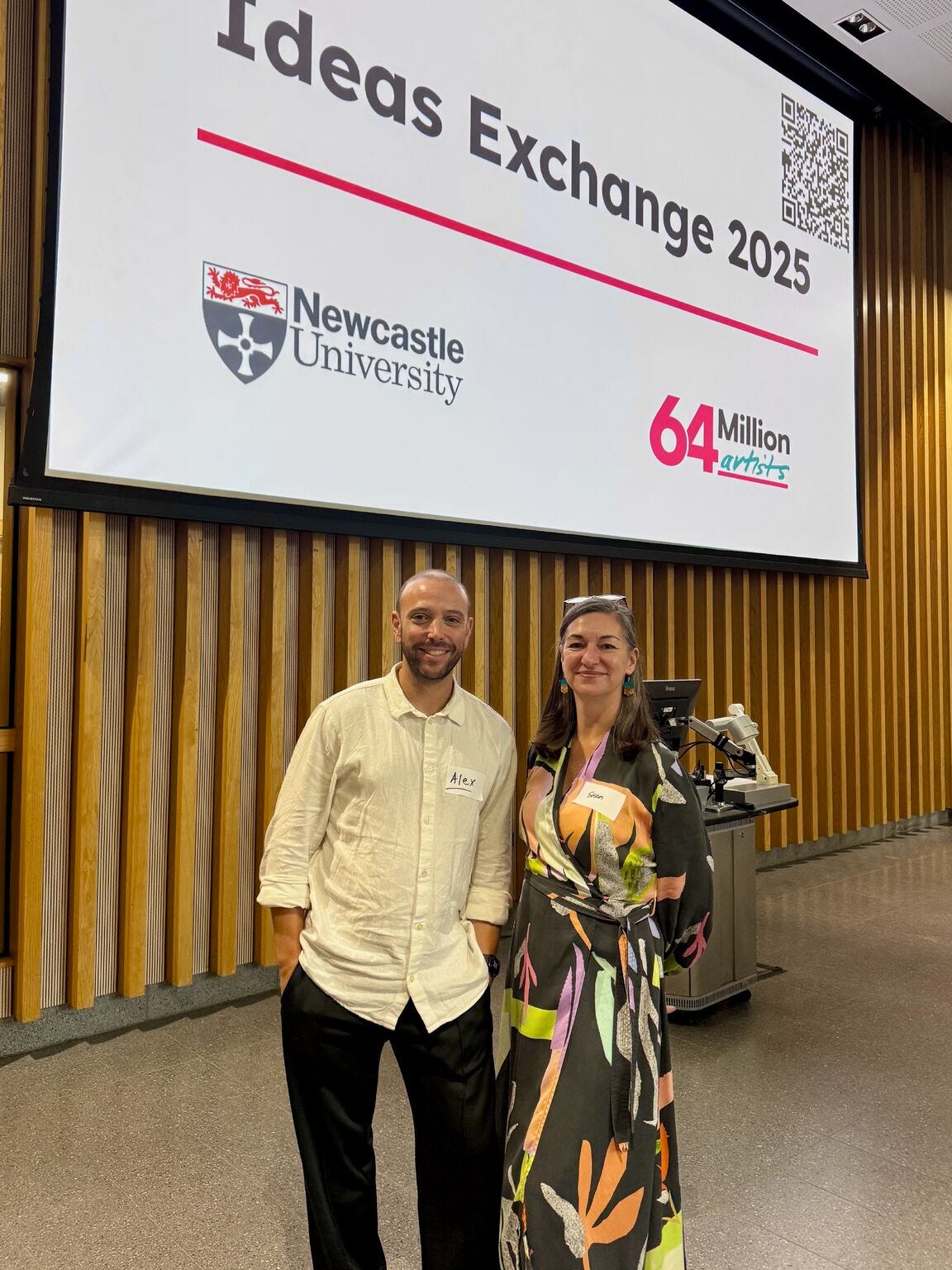
Me and Alex at the Newcastle University Ideas Exchange, part of the Leading Researchers Programme for 64 Million Artists
Joining online conversations
My woeful social media engagement makes me feel like a luddite at times. I’ve never really made sense of social media if I’m honest. I have a bit of a presence on LinkedIn and I’ve been writing here for the last two years as a thinking space. But that’s about it. I would love to launch some new digital products in the future, which I realise will require reaching beyond my usual network and likely via social media (sigh).
I did once join a rant on X about whether Arts Managers should have MBAs, which led to a Curious Conversation offline and sometime later, a project commission from the person that started that conversation. But other than that, I’ve never generated much work through these interactions.
Constellation of Collaborators
Technically, I began as a ‘solopreneur’, but I really don’t associate with that term. Not least because it conjures up images of Star Wars and Harrison Ford on a mission. Don’t get me wrong I love Star Wars, but I don’t relate to the concept of being a lone wolf, which this term suggests to me.
My business is bigger than me. I might not employ anyone, but I perceive my business as encompassing my clients and collaborators, partners and mentors, and the wider network of people that I come into contact with. Consciously or unconsciously, I’ve been nurturing a constellation of collaborators that not only make the work fun and enrciching, but are in many ways the life blood of my business.
I’m a people person, naturally curious and pretty generous (within boundaries). My buisness is built on energetic exchange. Time spent exchanging energy and ideas with people is always a good investment. I don’t want to be humble about the quality of my work. It’s very good. But there are lots of great people out there doing great work. My business thrives on the quality of my relationships, not just the quality of my work.
I’ve been so lucky to work with some amazing people over the last 10 years1 on everything from long-standing collaborations, small one off gigs and thinking / writing partnerships. Sometimes the line between paying client and collaborator becomes really blurry. And I’m ok with that. All have been incredibly valuable in shaping my practice. Check out the footnotes for details of some of these folks - they all do amazing work. Special mention to the brilliant Gill Thewlis, who is Co-Director at Modfin (my second business) and Co-Creator of Making Money Meaningful (coming soon!). It’s been so important to build something together over a sustained period of time.
I’ve come to believe that the real heartbeat of any business is the relationships that sustain it. The people we build with, learn from and grow alongside. It’s not the number of contacts that counts, or the size of a following, but the quality of the connections we nurture. The trust, generosity, reciprocity and curiosity we bring to them. When those relationships are healthy, honest and tended to with care, the work feels lighter, the opportunities feel brighter, and the whole journey feels more human.
If you’re taking stock of your own business or practice, you might ask yourself:
Which relationships in my ecosystem feel energising, and what helps them stay that way?
Who are the people I want to grow with over the next few years?
What small act of generosity, appreciation or curiosity could I offer this week to strengthen the relationships that matter?
How can I design my work in a way that allows more connection, not less?
Thanks for reading and hope some of these insights are useful :)
Some amazing people to look up and connect with:
Alex Eisenberg - creative facilitator, leadership development, team strategy and artist
Amayah Pelegrin - creative strategist, coach and facilitator at The Field
Anna Dinnen - organisational development
Dr. Claire Tymon - creative civic engagement leader and researcher, Founder at LOCAL
Charlotte Glazier - urban greening pioneer & Director UK Pocket Parks
Deepa Naik - cultural strategist and researcher
Filomena Rodriquez - creative coach, facilitator, energy worker
Gill Wildman - strategic designer, Director Plot & Upstarter incubator
Helen Brewster - innovation coach, facilitator and trainer at ATL Solutions
Lisa and Brendon Westcot Wilkins - Co-founders at Dig Ventures
Lynsey Smith - creative economy consultant
Maria Askew - cultural leader, educator and facilitator
Paul Sturrock - building curiosity driven businesses at ClimbWorks - the world’s first unaccelerator
Pete Frost - Urban Green Infrastructure Advisor at Cyfoeth Naturiol Cymru / Natural Resources Wales
Simon Cronshaw - cultural entrepreneur and Co-Founder at REMIX Summits